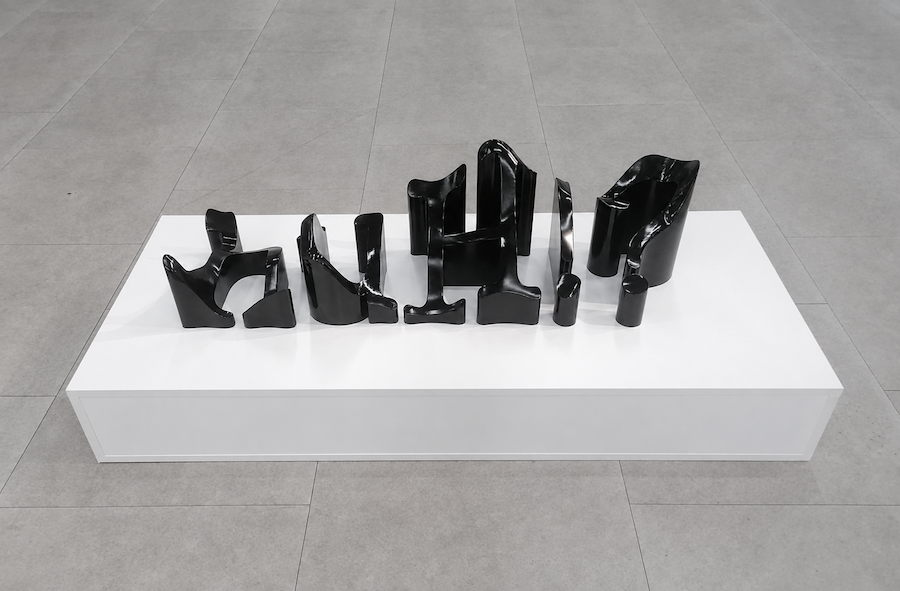
THE MOST WORDY WORD IN THE WORLD
Sculpture, impressions 3D, 2026.
Exposition : LKHAM gallery Oulan-Bator.
Selon une étude des plus sérieuse publiée par des chercheurs en linguistique de l’Institut Max Planck (Pays-Bas), l’onomatopée « huh !?
» serait le mot partagé par le plus grand nombre de langues au monde, transcendant les frontières géographiques, linguistiques, culturelles et nationales.
On pourra relever l’ironie du fait que ce mot, quasi universellement compréhensible, exprime paradoxale- ment l’incompréhension face aux propos d'autrui.
Transposé en objet, il devient ici motif sculptural.
La typographie donnant la forme aux lettres renvoie directement à l’univers de la machine à écrire, premier outil de mécanisation du langage et ancêtre de nos claviers numériques actuels.
Le volume reproduit quant à lui le relief de l’onde sonore créée par la voix humaine prononçant le mot « huH !? », donnant un caractère liquide aux courbes d’un noir d’encre dessinées par la sculpture.
Impression 3D : Christophe Gregorio.
[EN]
THE MOST WORDY WORD IN THE WORLD
Sculpture, 3D prints, 2026.
Exhibition : LKHAM gallery Ulaanbaatar.
According to a rigorous study published by linguistics researchers at the Max Planck Institute (Netherlands), the onomatopoeia "huh!?" is the word shared by the greatest number of languages worldwide, transcending geographical, linguistic, cultural, and national boundaries.
It is ironic that this word—understandable almost everywhere—paradoxically expresses a lack of understanding regarding what someone else has said.
Transposed into a physical object, it becomes a sculptural motif here.
The typography shaping the letters directly evokes the world of the typewriter—the first tool for the mechanization of language and the ancestor of today’s digital keyboards.
The form itself reproduces the relief of the sound wave created by a human voice uttering the word "huH!?", lending a fluid quality to the inky-black curves defined by the sculpture.
3D printing: Christophe Gregorio.